Posts Tagged ‘Spot On’

Twitter & Customer Service Survey

Monday, March 29th, 2010

Scroll down the page for survey download links

Summary

It’s now well publicised that the rapid growth Twitter experienced during 2008 and the first months of 2009 slowed dramatically towards the end of 2009, although ending the year with 75 million user accounts. Twitter activity, on the other hand, grew from 5,000 tweets per day in 2007 to 300,000 by 2008 and 2.5 million tweets per day in 2009. Figures released by Twitter in February 2010 registered 50 million tweets per day (or an average of 600 tweets per second). No such figures are available for the Middle East & North Africa, but activity on Twitter has visibly increased over the past year and overall user numbers have also grown. Spot On estimates that there are currently 35,000-40,000 registered Twitter users in the region compared with a mere 3,000 users in March 2009.

Corporate activity in the MENA Twittersphere has grown too, with an estimated 400 brands represented on Twitter in the region including companies, government departments, NGOs and non-profit organizations (more than 300 can be tracked via Spot On’s Middle East Brands Twitter List). Spot On Public Relations conducted the first major MENA Twitter habits and demographics survey in August 2009. In light of the growing commercial interest in Twitter and social media in the MENA region, Spot On carried out a customer service and Twitter survey in February 2010. About 1,000 active Twitter users across the region were invited to take part in the survey and 174 users completed the survey in its entirety.

Key Findings

Brand engagement 95% of respondents welcomed brand engagement via Twitter

87% of those surveyed said that Twitter had affected their perception of a brand or company (up from 61% in our August 2009 survey)

50% of those surveyed had received customer service via Twitter

Buying Via Twitter

50% of the survey had purchased a product or service as a result of Twitter

65% of respondents were interested in receiving special offers & coupons from brands on Twitter

82% admitted a preference for brands that they knew via Twitter that affected their purchasing

88% of those surveyed said that they would recommend a brand based on their experience on Twitter

All respondents were also asked to give one piece of advice to brands using Twitter. 101 Twitter users out of 174 contributed advice from their experience on Twitter. We highly recommend any brand that is using Twitter or considering using Twitter to read their advice in the survey report.

You can follow Spot On PR on Twitter via @spotonpr

Survey Downloads

The report: 101 things brands should know about Twitter (PDF)

Twitter and customer service survey press release (English, Word doc)

Twitter and customer service survey press release (Arabic, Word doc)

- – - -

Creative Commons

101 things brands should know about Twitter by Spot On Public Relations is licensed under a Creative Commons Attribution-No Derivative Works 3.0 United States License.

Want to read more?

If you liked reading this post about Twitter, you might also like:

Tweets like grains of wheat

5 reasons Spot On PR uses Twitter

The uninvited guest at the party

Spot On PR’s MENA Twitter Demographics & User Habits Survey (2009)
The Year Of Mobile?

Sunday, January 24th, 2010

Spot On PR Mobile

I’ve been listening to technology pundits predict each new year to be the year of mobile for many years now. Some have written so many annual opinion pieces heralding “The Year Of Mobile” that it almost defies belief that they can still write about it with the same conviction. I might be forgiven for filtering this year’s predictions with a little skepticism, but also for pointing out that actually we have been moving ahead, year after year, with the adoption of mobile platforms and the increasing capability of those platforms and the networks that serve them. So, is it “The Year Of Mobile”? Or not?

Jared Reitzin, CEO, mobileStorm Inc., blogging on Mobile Marketing Watch, believes that it is now safe to say 2010 is the official year.

Blogger, ex-Forrester Research analyst and managing director of Dachis Group Peter Kim too blogs “2010: The Year of Mobile”.

Joe Marchese, president of socialvibe, says in his Mediapost.com “2010, The Year Of Mobile — Finally” saying in his piece that “2010 will be the year mobile marketing begins to realise the promise marketers have imagined for so long”.

Even The Times seems to concur that 2010 is “The Year Of The Mobile’ and quotes from December’s Morgan Stanley mobile Internet report, which says that “the mobile Internet is ramping faster than the desktop Internet did, and we believe more users may connect to the Internet via mobile devices rather than desktop PCs within 5 years”.

Peter Kim credits better mobile phone functionality, growing choice of applications and increasing access via 3G and Wi-Fi hotspots with helping to boost the value that consumers get out of their mobile platforms (and new opportunities for marketers). We happen to agree over here at Spot On. We’ve seen social media adoption ramp up in direct relation to the availability of broadband Internet and a decrease in cost of broadband services. And so it stands to reason that an upswing in mobile broadband and Wi-Fi access has got to be good for mobile Internet adoption and mobile marketing.

It’s no secret that the arrival of Apple’s iPhone two and half years ago really stirred up the smart phone market and, among other things, showed device manufacturers, developers and carriers how to make networked mobile applications appealing. Today, Apple, Google, Nokia, RIM and others are all focused on helping to create easier-to-use, more content rich mobile services platforms that have mass consumer appeal. Innovations like Google’s voice search for mobile, new applications based on location based services and m-commerce consumers services using barcodes all point to mobile phones playing an increasing pivotal role in our day-to-day lives.

There’s arguably no “Year Of Mobile”, but an ongoing trend that is changing the communication game. However, if 2010 is the year when we will come to recognise the need to bring that platform into our thinking as marketers, then perhaps it could be, at last, the year! As Peter Kim says, mobile is fast becoming another check box for integrated marketing. As with social media platforms, mobile is going be become increasingly important to marketing and the only decision that marketer’s need to make is when the time is right to go mobile. We’ve already decided and so you may already be reading this blog post on our mobile site http://m.spotonpr.com

Some interesting links

2010: The Year of Mobile (Being Peter Kim)

2010, The Year Of Mobile — Finally (Mediapost)

2010 IS The Year of Mobile (Mobile Marketing Watch)

2010: the year of the mobile (The Times)

The Mobile Internet Report (Morgan Stanely)

Video: Mobile Apps Roundtable at Le Web (Ustream)

5 reasons Spot On PR uses Twitter

Monday, January 18th, 2010

Using Twitter for business@SMEXbeirut asked recently if we’d written an article on why Spot On PR uses Twitter and what we get out of it, so now is probably as good a time as any. Those that have been following our social media efforts will know that we embraced Twitter almost as soon as it was unblocked in the UAE mid-2008. We already knew that Twitter could be a great connector of people and that it was another key piece of the social media puzzle. One and a half years on, and even with Twitter’s growth flat-lining (see Mashable story from 11 January), we still believe it offers great value to communicators.

As a communications, PR and marketing agency Spot On is committed to Twitter for 5 key reasons.

1. Twitter helps MENA’s web community join up the dots.

The Middle East and North Africa is becoming increasingly web-friendly with online ventures, web developers, application developers, bloggers and social media power-users growing in numbers across the region. However, despite the Internet’s ability to make location irrelevant, a great deal of talent and knowledge is local and focused on national opportunities and knowledge sharing and collaboration across borders has lagged a bit. Twitter allows web-friendly people across the region stay in touch daily and brings them closer together. Using Twitter, Spot On is able to swap notes and follow the news from these audiences across the region, on a daily basis and at no charge.

2. Content producers, aggregators and distributors love Twitter.

In last year’s Spot On MENA Twitter Demographics & User Habits Survey we found that 65% of those surveyed were bloggers. Furthermore, nearly 80% of those surveyed interacted frequently with bloggers via Twitter. The Middle East and North Africa Twitter community remains a relatively small one, but it’s an influencial crowd and this is because many of those using Twitter in the region are involved in the creation, distribution or sharing of content as bloggers, social-media power users, journalists or communications professionals (some 35% of those in our survey worked in public relations, media or marketing). Twitter helps us keep up-to-date with new blog posts, breaking media stories and content recommendations.

3. Twitter provides a useful media relations tool.

Spot On follows more than 150 journalists from across the Middle East and North Africa and has added them to its private Twitter Lists in order to have the ability to browse all their tweets in one screen. Like most PR agencies, we deal with hundreds of journalists and we simply don’t have the time to talk to many of them as often as we would like and listen to what’s on their minds. Twitter helps us keep up-to-date with journalists news and latest stories. We also quite often receive client-related enquiries from journalists via Twitter.

4. Twitter helps you discover the unexpected.
Twitter is great discovery tool. It can introduce you to new information, news stories and people every day. However, we often find that people we wouldn’t normally think of, or deal with very much, share some of our interests and we have rather more to talk about than we expected. Discovering unexpected interests and synergies is a huge Twitter benefit and its helped us strike up conversations with some very interesting people and organisations. It’s also, of course, introduced us to new blogs, bloggers, journalists, communications and marketing professionals and other interesting Tweeple.

5. Twitter can be a window allowing others to see more of your company.

I suppose that business development is what pays for our time to do all the other good stuff on Twitter and other social media. Twitter gives us another platform to share information on Spot On, what we’re doing, what we’re thinking and what we’re interested in, which is a great way for potential clients to get to know us a bit better before getting in direct contact. It’s like opening a little window that lets people see more of what’s inside the company and tune in a little bit better to what we’re thinking. It’s also a useful platform to promote our blog and other social media activities. Twitter has introduced us to a number of new clients and new potential clients, that we probably wouldn’t be talking to if we weren’t on Twitter.

If you’re not already following us, you can follow Spot On Public Relations on Twitter here: @spotonpr

Spot On PR’s MENA Twitter Demographics & User Habits Survey

Thursday, September 10th, 2009

Scroll down the page for survey download links

Summary

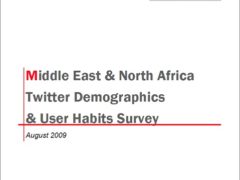
2009 has been a big year for Twitter with the micro-blogging platform’s rate of growth rocketing up to more than 20% per month and now showing annual growth of 1,460 percent (June 2008 to June 2009) according to Comscore. Although it’s still early days for Twitter in the Middle East and North Africa, Twitter is now growing fast and the numbers of Twitter users in the Middle East and North Africa is now increasing at a rate of 17% per month. The MENA Twitter community overall has increased ten times over the first seven months of 2009.

MENA Twitter Users By LocationSpot On Public Relations has been active on Twitter since August 2008,  has been tracking Twitter usage in the MENA region  and, in the absence of any data on the region’s Twitter growth or demographics, has been conducting its own research. This report is the result of the region’s first extensive Twitter usage survey which focuses on the demographics, Twitter habits and experiences of a sample of 216 registered Twitter users across the Middle East and North Africa.

Here are some of the MENA Twitter Survey’s key findings:

54% of respondents are following 100 – 499 other Twitter users

53% of users surveyed have 100 – 499 followers

35% of Twitter users tweet 2-5 times per day

64% typically tweet every day of the week

Contrary to global trends, twice as many men in our Middle East and North Africa survey use Twitter than women (other surveys show a similar male bias on Facebook in MENA)

99% of those surveyed tweet in English, 26% tweet in Arabic

Only 50% of Arabic speakers tweet in Arabic

39% tweet mainly with other Twitter users in the Middle East

61% of MENA Twitter users surveyed say that Twitter has affected their perceptions of a brand

70% of MENA Twitter users say they have formed a more positive perception of a brand due to Twitter and 52% say that they have formed a more negative perception of a brand due to Twitter

48% of users surveyed say that they have often been alerted to a major story via Twitter, 54% say that Twitter has lead them to a blog or website and 21% say that they have tuned into a TV program as a result of Twitter

32% of users say that they have bought a product or service as a result of recommendations on Twitter

96% of users expect to continue to use Twitter as much as they do today or even more in the future

Survey Downloads

Middle East & North Africa Twitter Demographics & User Habits Survey (PDF)

MENA Twitter Survey Press Release (English, Word doc)

MENA Twitter Survey Press Release (Arabic)

Bookmark this page to keep updated with new downloads on the survey

- – -

Creative Commons License
Middle East & North Africa Twitter Demographics & User Habits Survey by Spot On Public Relations is licensed under a Creative Commons Attribution-No Derivative Works 3.0 United States License.
Permissions beyond the scope of this license may be available at http://www.spotonpr.com/menatwittersurvey/.